
Alex Garland and Ray Mendoza’s latest A24 film presents a simple premise: Warfare, a movie built from war veterans’ accounts of a specific mission in Iraq. In the war film genre, that’s nothing particularly new, so what makes Warfare stand out?
From the same creators who brought us “no CGI” and “all in-camera effects,” comes: “There is no soundtrack in real life.” “This is as close to real combat as it can be.” Studios are still struggling to convince people to leave their homes and go to the theaters. Sidebar moment aside, Ray Mendoza’s experience as a U.S. Navy SEAL and his ultra-realistic approach does bring something interesting to the table. I wouldn’t call it fresh, because, when it comes to war movies, freshness isn’t really the point.
Putting aside my irritation with how studios have been marketing their productions lately, let me say a few things about this film.
On War Movies
There’s a line to be drawn between war movies and action movies. Do war movies have action (as in gunfire and explosions)? Yes—but not always. Are all movies set during war actually war movies? No. They might just be action flicks in military clothing.
So, what makes a war movie… a war movie?
The thing with action movies is that they thrill you. Think Mission: Impossible. War movies, though, use violence to shock, provoke, and make a statement, often an anti-war one. I’ve noticed this in many of the films I’ve been watching on my journey to create a concise WWI and WWII timeline using cinema.
The challenge is that we (filmmakers) tend to turn our protagonists into heroes. And in a society that needs heroes, the intended anti-war message often gets lost. Just look at the whole Elite Squad conundrum: a movie made to critique violence ends up being embraced as a pro-violence anthem.
Warfare tries, and succeeds, to avoid the war-movie trap with two smart decisions:
1. A façade of no character development.
What do I mean by that? This is a 90-minute movie. There’s no time to go back to the characters’ childhoods or include heartfelt letters from loved ones. War doesn’t care about backstory. And this decision works. Why even try to give all 18 characters detailed arcs so the audience can “care”? And yet, a three-minute introduction set to Eric Prydz’s Call on Metells you everything: their age range, their camaraderie, their naïveté. It’s enough. We can fill in the blanks.
2. No reliance on war-movie archetypes.
You know the ones: the rookie, the wild-eyed officer, the grizzled commander, the idiot. Sure, there’s a “new guy” here too, but the interactions are professional, efficient. They’ve been trained. They have a mission. That’s it.
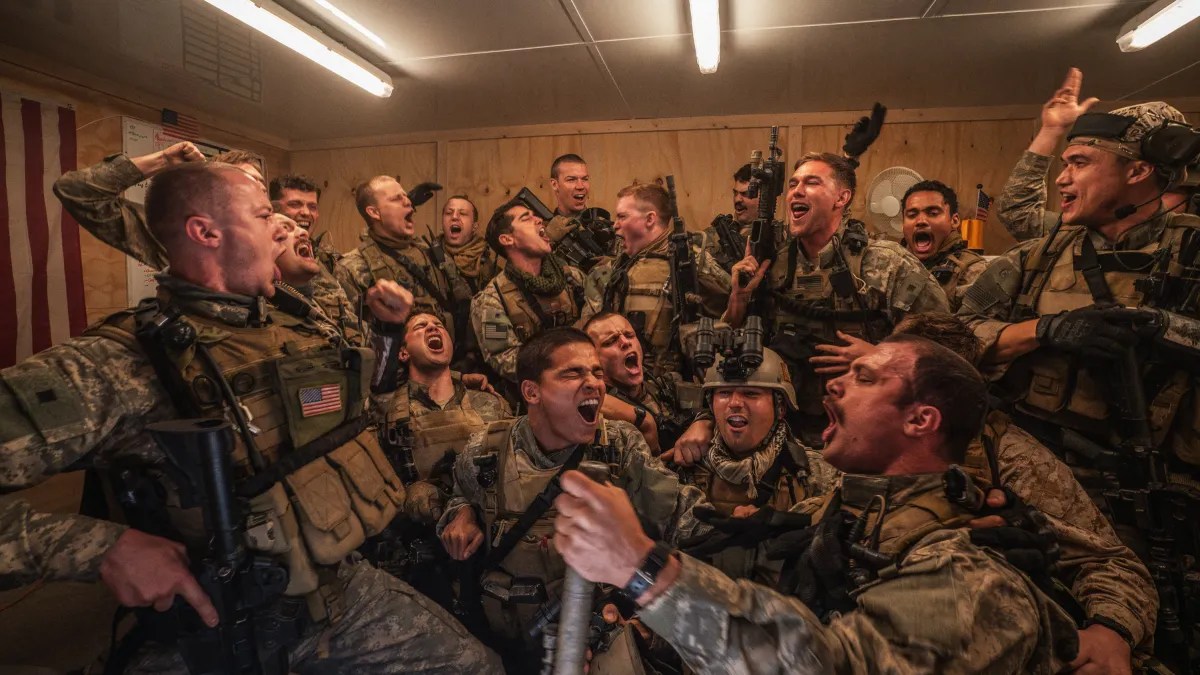
The Hyperrealism
Mendoza’s insistence on having no music score is understandable. Many films go scoreless during action scenes to boost realism. And in Warfare, that realism hits hard. That said, there’s a clever use of radio chatter and off-screen sounds that fills-in for the score.
When everything blows up, chaos breaks loose—and Garland knows how to portray chaos. We saw it in Civil War, and here it’s just as effective. The Navy SEAL platoon is bunkered in a house. Time is ticking. They need to escape. Light is outside; darkness is where they are.
Tight space cinematography makes impossible for the audience not to feel inside the action. You’re as stunned as the soldiers when their brothers die or suffer brutal injuries. But there’s no time for sorrow—this is happening in real time. D’Pharaoh Woon-A-Tai’s face says everything, even when words don’t.
Powerless
The need to escape and save their friends leads to calls for backup and extraction. Ground combat, war—it levels everyone. Whether you’re a Navy SEAL or an Iraqi resistance fighter (or “military-aged male,” as the film puts it), there’s no such thing as supremacy when bullets are flying and death is close.
The air support’s low flyby (show of power), yes, it is cool, is a metaphor for how even the world’s most advanced military can’t solve the brutal reality of ground warfare. When men are killing men, there’s no power left. Even when reinforcements arrive, you do hear the cliche military screams of encouragement, but they are silenced. Meaningless.
In the end, they escape. But war never escapes them. The question of why they were even there will haunt them forever. A pivotal scene shows Will Poulter’s character simply… apologizing. As they retreat, the sound of gunfire fades. The Navy SEALs are safe—but they’ll never be the same. Life resumes in the city. The enemy has been pushed back. They’re on retreat. Irony .
Warfare, with all its cinematographic apparatus, or not, succeeds in telling a powerful story while sidestepping familiar tropes. It’s a war film that balances shocking realism with frenetic pacing—a war movie that, as it should, makes you care for the thousands of soldiers sent to fight (even if you don’t know them) and question whether the fight is worth it at all. But it might be asking too much from today’s audiences.
 Pipoca Crítica
Um comentário sobre “Warfare”